
Standing Orders : The best obedience is the kind you never have to ask for twice

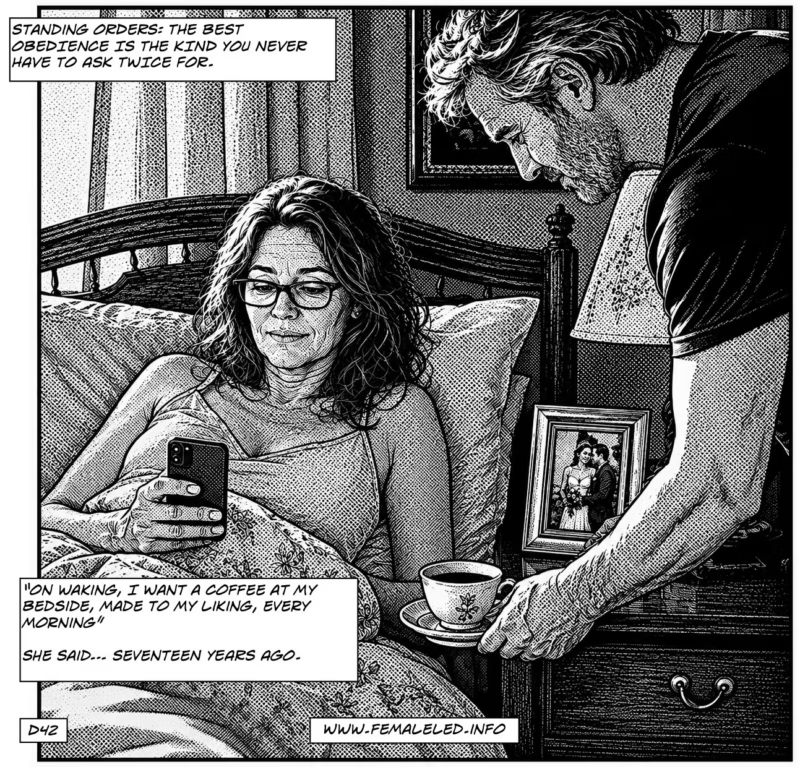
There is a habit you keep, darling, that costs you more than any of his. It is the habit of saying things twice.
The kettle. The shirts. The car booked in. The reminder, on Thursday, that the bins go out on Friday, delivered the way you always deliver it, into the same mild silence. None of it is hard. That, precisely, is the problem. It is not hard, it is constant, and it is yours. You designed a household to be led.
Somewhere along the way you became its secretary.
A standing order ends that. Not a chore. An order that stays standing.
Said once
A one-off command is something you say. He hears it, he does it, the matter closes, and tomorrow you say it again. A standing order is something you say once, and then never. The kettle is on by half past seven because the kettle is on by half past seven. The shirts are pressed on a Sunday because Sundays are when the shirts are pressed. You have removed yourself from the loop and the loop, sensibly, runs without you.
This is the line between a Level 3 dynamic with rules and a Level 4 one with protocol. At Level 3 you supervise. At Level 4 the supervision is built into the architecture of his week, and you have your Tuesday afternoons back to read or to take a lover or to do nothing at all, which is, frankly, the point.
Begin small, or do not begin
Do not install a regime on a Tuesday and expect a transformed man by Friday. You will get a flustered one, and you will spend the week reminding him of the very orders meant to spare you the reminding.
Pick one. Make it the one you will see daily and the cost of failure is low. The morning coffee. The state of the bathroom. The car, fuelled before you ask. Something you cannot miss, every single day, done or not done. He learns that this thing is now simply true, the way Tuesday is true, and once it has settled you add another. Patience here is not a virtue, it is strategy.
State it. Name it. Stop talking.
The standard is the part most women fudge, and fudging is fatal. “Keep the kitchen tidy” is not an order, it is a mood. “The kitchen is clean and the dishwasher running before you come to bed, every night,” is an order, because he can fail it precisely and you can both see that he has. Vagueness is generosity to the wrong party.
And then, the discipline that will cost you the most: you do not remind him. The reminder is the failure state. The second you say it twice you have taught him that the order does not hold until you chase it, and you are back at your desk, secretary again. Let the order stand. If it falls, that is information, and information is what you wanted.
The day it lapses
It will lapse. He is a man, not a metronome. The first lapse is not a betrayal, it is a test of your design, and the design is your response.
The response is quiet. It is certain. It is not a scene at the door, it is not a sulk over dinner, it is not, God spare us all, a conversation. He knows the order. He knows it was not kept. You do not need to raise your voice to a man who already understands what he has done; you need only let him understand that you noticed, and that noticing has a price. What that price is, is yours. That there is one, every time, without negotiation, is the whole thing. A standing order enforced once a fortnight is not an order, darling. It is a hint.
What it will take, and what it won’t
Not everything takes a standing order, and pretending otherwise is how women end up with a man performing the letter of forty rules and the spirit of none.
The domestic, the routine, the thing with a clear shape and a daily rhythm, those take it beautifully. What does not take it is anything that needs you in the moment: your mood, your reading of him, your particular wanting on a particular night. You cannot put a standing order on the way he ought to look at you across a room. That stays live, and so it should. The skill is sorting the two. Automate the labour. Keep the attention.
A few worth stealing
Beginner
- Coffee on your bedside table before you wake. Every morning. Never mentioned.
- Phone face-down in the hall bowl on arrival. It stays there until you say otherwise.
Intermediate
- Your clothes laid out, your shoes cleaned, ready for you each morning. Your turnout, his standing charge.
- His card statement open on the table, Sunday evening. Brought to you, not requested.
- The same act of devotion recited each night before sleep, unprompted, word for word.
- Your feet in his hands every evening once you are settled, without fail, until you tell him to stop.
The compliment you are paying him
Here is the part nobody tells you, which is also the part that makes it worth doing.
A standing order looks like work you have handed him. It is not. It is your attention you are withdrawing, and the withdrawal is the reward. Think about what you are saying when the coffee simply appears and you never had to think it. You are telling him he has earned the right to serve you without occupying one second of your mind. He has become reliable enough to vanish into the running of your life. For the right man, that is not demotion, it is everything he ever wanted: to be necessary to you, invisible in his necessity, both at once.
You stop managing him. You begin, simply, receiving him.
The trick of the thing
One order, this week. The standard named once, in full. The reminder withheld. The lapse met, quietly, the first time it comes.
Then the second, when the first has gone silent. Then the third. And one ordinary Wednesday a few months on you will come home at half past seven to a warm kitchen, a poured glass, and a man who needed telling none of it, and you will realise the house has been running on your terms for weeks, entirely without you.
That is the whole of it, darling. The best-run household is the one that no longer requires you to run it.



So appreciate the directness and clarity dominant women provide in their interactions with submissive men – such as myself. Men need female-led direction in their lives; in fact, men like me, thrive on it. We wish to be pleasing to the women we are privileged to serve and submit to. Thank you for this article and your advocacy for a more female led future.
– john
Great post thank you
This is one of your best for explaining how ideally the FLR dynamic should work at level 4. It can be related to what you have explained in a previous post:
“Submissive men want to perform daily tasks, prioritise your needs, and follow strict rules and protocols. They are not only willing but eager to handle household chores, run errands, and ensure that every aspect of your life is smooth and enjoyable. This kind of service-oriented submission is about more than just doing chores—it’s about showing love and commitment by making your life easier and more pleasurable.”
To do that, he needs an established routine which doesn’t require you to remind him. That gives you the peace of mind to not have to think about it. “You are telling him he has earned the right to serve you without occupying one second of your mind. … The best-run household is the one that no longer requires you to run it.”
What he needs is a calendar or app with some tasks being daily, and others once or twice a week, or whatever. That way, he doesn’t need to remember everything, and nor do you. Ideally, if it is an app, he could record when he completes each task with a few taps on a mobile, and you can review that at a time of your convenience.
Thank-you for this. It is excellent guidance.
I only wish to serve my Lady and have my service ease her burden, please her and not tax her in any way.