
Anticipation Is Obedience in Advance

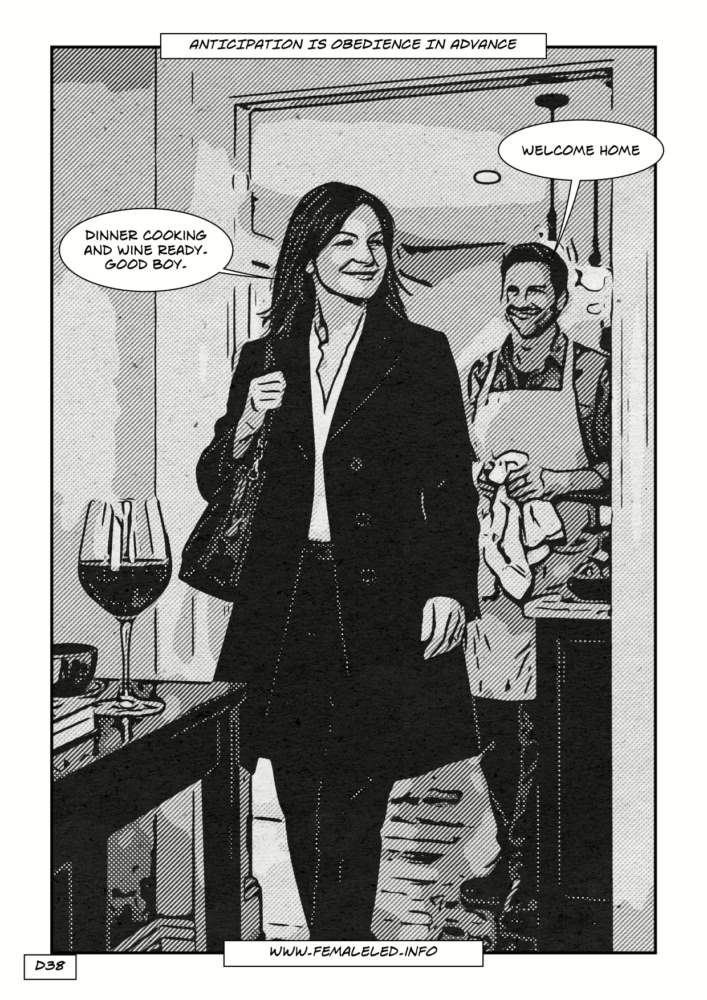
Let me paint you two pictures.
Picture one: You walk through your front door after a day that would have broken a lesser woman. Your shoulders are carrying approximately seven thousand decisions and one colleague who really ought to know better by now. You drop your bag. You look at the kitchen. The dishwasher light is blinking like a passive-aggressive lighthouse, the counter has achieved a level of chaos that suggests unsupervised toddlers, and your man is on the sofa, alive, functioning, possessed of two working hands, apparently waiting for a sign from the universe.
Picture two: Same day. Same door. You walk in and the lamps are already on the warm setting because he knows you hate overhead lighting after six. There is a glass of your preferred wine breathing on the counter. The kitchen is clear. He appears, briefly, to let you know dinner is forty minutes away, and then he disappears, because he also knows you need twenty minutes of silence before you want to see anyone’s face, including his.
Same man, by the way. Different woman leading him.
That second version of your life is not luck. It is not a particularly evolved specimen you happened to find on a dating app. It is the result of intentional, unapologetic female leadership applied to a man who has been taught, very clearly, what it means to truly serve you.
The principle at the heart of it is this: anticipation is obedience in advance.
And once you understand it, you will never be satisfied with the reactive kind again.
What It Actually Means
Most people think obedience looks like this: she speaks, he moves. Command and compliance. She says jump, he asks how high, which, charming as that is, still requires her to say jump in the first place.
That model works. But it also means you are the engine of your own dynamic. You have to stay switched on, issuing direction, catching what he missed, repeating preferences you have already expressed forty times as if they are breaking news. At level three or four, that is not power. That is unpaid project management.
Anticipatory obedience is something far more satisfying. It is him internalising your standards so completely, paying such close and devoted attention to who you are and what you want, that he acts on your preferences before you have to voice them. Your authority stops being something you have to exercise every five minutes and starts being something he carries around in his head all day, shaping his choices even when you are nowhere near him.
He makes the bed the way you like it. Not because you are standing there watching. Because he has learned, and he would not dream of doing it any other way.
That is not a man following orders. That is a man whose entire attentive self is quietly, constantly oriented toward you. And honestly, there is something rather delicious about that.
Why This Is Exactly What a Level 3/4 FLR Needs
At levels three and four, you are not playing at this. Power exchange is not an accessory you clip on at the weekend. It is the architecture of the relationship. Which means the way he obeys matters enormously.
Reactive obedience, at depth, creates a problem that nobody talks about enough: you become the bottleneck of your own authority. If he only acts when prompted, your leadership is contingent on your constant participation. The moment you want to simply exist in your relationship without directing traffic, things start sliding.
Anticipatory obedience removes that bottleneck entirely. Your standards run even when you are quiet. Your preferences shape his behaviour on days you say almost nothing. The house runs well not because you managed it but because you led it, which is an entirely different thing, and a much more enjoyable one.
There is also something to be said for what it does to the intimacy between you. A man who anticipates your needs is paying more concentrated attention to you than practically anyone else on earth. He is studying you. Learning you. Remembering the small things and acting on them. For a dominant woman, that quality of focused devotion is not a footnote to the dynamic. For many of us, it is the whole point.
And for him? Men in serious FLRs will often tell you that anticipatory service puts them in a state of quiet, steady fulfilment that reactive compliance simply does not. He is not a vending machine waiting for your coin. He is actively, continuously engaged in his submission. Which is, it turns out, exactly where you want him.
Real Examples, Because Theory Is All Very Well
Let us get specific, because anticipatory obedience looks different depending on the room you are in.
The bedroom, since we are all adults here: You should not have to set the scene every single time. A man at this level of the dynamic knows what prepares you. He knows the order of things, the atmosphere you want, the pace that is yours and not his. He draws the bath without being asked. He puts on the playlist. He does not arrive at the bedroom with the energy of a man hoping to negotiate terms. He arrives prepared to serve you on your terms, because he has been paying attention and he has learned that your pleasure is the point, full stop. The evening begins according to your appetite, not his. And if that appetite does not include him at the centre of it? He handles that graciously too, because a man who truly serves you serves your satisfaction, not his own ego.
The domestic, which is not beneath your attention: He does not wait for the house to deteriorate to the point where you comment. He maintains your standards as if they are his religion, because in this relationship, they are. When you mentioned once, three months ago, that you hate finding splashes on the bathroom mirror, you should never have to mention it again. That is not a chore completed. That is devotion expressed through a clean mirror, and yes, you are allowed to find that meaningful.
His body and presentation: At level three and four, many women have strong preferences about how their man presents himself. His grooming, his fitness, what he wears. A man who anticipates knows that you notice when his standards slip, even if you say nothing. He does not wait to be told to book the haircut. He does not wait to be told the shirt you dislike has crept back into rotation. He self-governs according to your preferences because he has internalised them, which means you get the man you want without having to manage him like a teenager. This is what it looks like when he takes your authority seriously even in your absence.
His social behaviour: You are at dinner with friends. Without a word between you, he manages the room in a way that reflects well on both of you, defers to you naturally in conversation, handles the bill without fuss, and does not start a second bottle when you have already signalled you are ready to leave. He read the room. He read you. He anticipated. And later, when you are home, you will let him know, in whatever currency you prefer, that it did not go unnoticed.
His emotional attunement: You are in a particular kind of mood. Not the kind you want to discuss. The kind you want respected. He does not pepper you with “are you alright?” as if checking in will somehow fix it. He makes himself useful, stays close enough to be present and far enough to give you air, and waits until you surface on your own timeline. Because he has learned the difference between the silence that wants company and the silence that wants quiet. That distinction takes time to learn. A man worth keeping puts in the time.
How You Build This, Because It Does Not Happen By Accident
Here is where I want to be direct with you, because this is where a lot of women get passive about their own dynamic. Anticipatory obedience is grown. You grow it deliberately, through how you lead. If you are waiting for him to develop it organically, you will be waiting a long time.
Paint him a picture of your life running well. He cannot anticipate a standard he does not know exists. Early in the dynamic, or when you are levelling up, spend real time articulating what your life looks and feels like when everything is working. Not rules. Not a checklist. A vision. What does a good morning in your home look and feel like? What does it feel like when you arrive somewhere and it is all handled? Give him that picture clearly and in detail, and then expect him to move toward it.
Acknowledge it when he lands it right. You do not need to make a production of it. “I noticed, and it mattered to me” is enough. But say it. Your acknowledgment is calibration. It tells him which of his observations hit the target. Over time, your satisfaction becomes the internal compass he navigates by even in total silence. That is exactly where you want to be.
Do not rescue him from missing the mark. When he falls short, resist the urge to simply handle it yourself. Name it. “I should not have had to think about that. You know my schedule, you know what that morning needed.” You are not being unkind. You are being instructive. There is an important difference, and a man worth leading will understand it.
Use your check-ins as real leadership tools. Regular dynamic conversations at this level are not optional, and they should not be purely pastoral. Ask him: “What did you anticipate this week that I did not have to ask for?” That question is more revealing than any checklist. It tells you whether he is paying the right kind of attention, and it signals to him that anticipation is part of what you are measuring, not a bonus extra.
Raise the bar incrementally. He learns your routines before he learns your moods. He learns your moods before he learns your subtler patterns. Do not expect the whole picture at once. Give him time and clear feedback, and watch the layers develop. The patience you invest here pays compound interest.
Tell him, explicitly, that anticipation is part of what submission means to you. Some men default to reactive compliance because it feels safer. They know they obeyed because they were told to obey. Help him understand that for a woman at your level, that is table stakes, not the summit. You want a man whose devotion is active and continuous, not a man who switches on when prompted and idles the rest of the time. That is a reasonable expectation. State it as one.
The Woman Whose Home Runs Before She Speaks
There is a particular quiet that settles over a woman who has got this right. It is not the quiet of someone who has given up or checked out. It is the quiet of someone who does not need to raise her voice because the room is already arranged the way she likes it.
She is not working harder than anyone else. She is working smarter, which in a Female-Led relationship means having led so well, so consistently, so deliberately, that her standards now live in someone else’s head and hands.
Her man does not need to be told what a good day looks like in her life. He knows. He is building it while she sleeps, while she works, while she sits in the bath with her book and absolutely no intention of thinking about the dishwasher.
He is not waiting for her permission to serve her well.
He already knows what well looks like.
That is not devotion as a performance. That is devotion as a practice. And the woman who has cultivated it in a man who is genuinely capable of it?
She is not running her relationship.
She is ruling it.



This is awesome! I do dishes and clean the kitchen regularly to my wife’s standards. This is a unspoken rule.
Thank you for this posting. I’m in my 60s (and just retired). My Lady is still working full-time and I’ve been learning how to do much more in my “free time”. You have articulated what I’ve been striving for (planning and making much more of the meals, walking the dog, keeping the house tidy, etc., so she hardly has to think of it). I’m still a work in progress, and I appreciate what you wrote.
More excellent advice. I liked this line particularly: “He is not a vending machine waiting for your coin. He is actively, continuously engaged in his submission.”
And yes, I think many women, even if they are FLR curious, underestimate the time and effort needed for “Anticipatory obedience to be grown.” Sana at flrindia.com talks about how it took her two years to train her submissive, two difficult years. When she says they were difficult, I think she means for both him (learning new habits, doing things her way because that’s the way she wants them done) and for her (patience and understanding with his rate of progress, communication about expectations and successes and failures, and even learning where he requires training that she innately assumed would be obvious). I love your idea that painting him a picture works better than rules and checklists. If he’s intelligent, giving him the big picture accomplishes more than a stack of rules and checklists. Although he may prefer or need to create a few for himself, especially as he’s ramping up.