
Using him for stress relief and calling it self-care

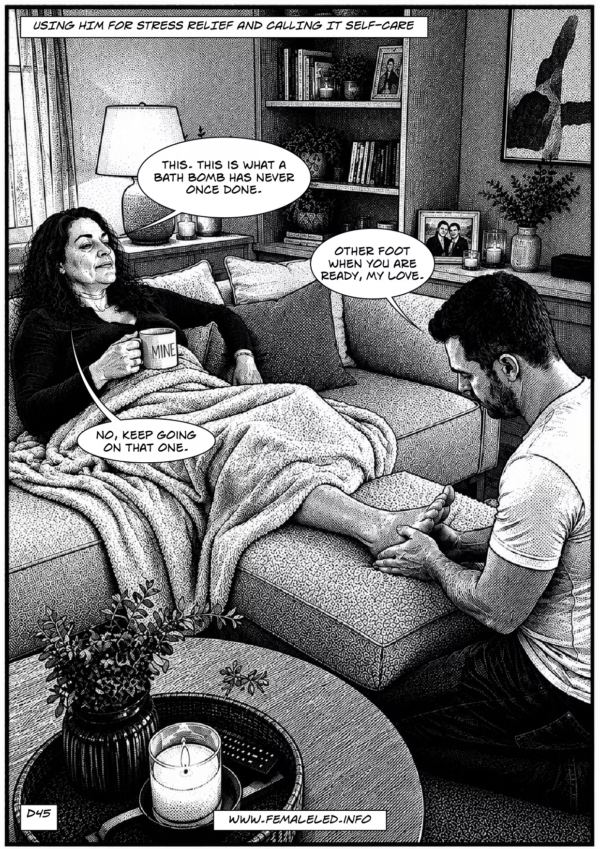
Somewhere along the way, darling, self-care became an industry designed to sell women things they do not need as a substitute for things they actually want. Candles. Sheet masks. A Tuesday evening alone with a glass of wine and a podcast about other women’s problems.
She bought it for a while. Most women do.
Then she had a particularly difficult Tuesday (the kind involving at least two people who should not be in positions of authority and one meeting that could have been an email), and she came home, looked at her partner, and thought: no. Not tonight. Tonight you are the self-care.
This, it turns out, is one of the more intelligent decisions she has ever made.
What she actually needs
Not to talk about it. Not to process it collaboratively over dinner while he offers solutions to problems that do not require his input. Not to manage his response to her stress while also managing the stress itself.
What she needs is to stop. To be still. To have her body attended to by someone whose entire focus is on her comfort, her pleasure, and the complete suspension of her need to be competent at anything.
This is not indulgence. This is regulation. The nervous system does not distinguish between a professional massage and a man who has been clearly directed to attend to her shoulders, her feet, and whatever else she nominates. What it registers is: she is safe, she is still, someone capable is handling it.
He is that someone. This is what he is for.
Using him is not abusing him
This bears one mention and does not require hand-wringing.
She is not taking from a man who has nothing to give. She is directing a man who wants nothing more than to be useful to her, who finds her need for him clarifying rather than burdensome.
He does not experience her stress as an imposition on his evening. He experiences it as an invitation to be exactly what she needs. Her difficult Tuesday is his opportunity. She should stop feeling complicated about it and start feeling considerably better.
The standing protocol
The point of using him for stress relief is that she does not, after a day of directing everything else, also have to direct this. This is where a standing protocol earns its keep.
He knows the signals. He reads her, moves accordingly, and begins.
The drink is already made, exactly how she takes it. The shoes come off without discussion. He does not speak first; he reads what she needs (silence, one quiet question, to be held without commentary) and provides it. Her body is the priority: shoulders, feet, hair, all of the above in the correct sequence.
His needs are not on the agenda. Tonight she is the patient and he is the very attentive, very capable, entirely uncomplaining treatment.
On asking for it
Some women will read this and feel a familiar resistance. I don’t want to have to ask. Which is precisely why the protocol exists, so she doesn’t have to. Beneath that resistance is often something older: the feeling that needing this makes her demanding. High maintenance. A lot.
She is a lot, darling. This is not a flaw in her construction.
The woman who has arranged her relationship so that her care is available without negotiation has not made herself a burden. She has made herself, correctly, the centre of an arrangement designed around her wellbeing.
He is not suffering. He is purposeful. There is a significant difference and she should internalise it completely.
What he gets out of it
The obvious beneficiary is her. Depleted on arrival, she is horizontal on the sofa within twenty minutes, a drink in hand, his attention moving across her shoulders with the focus of a man who has nowhere else to be. Her nervous system has stopped broadcasting emergency signals. The difficult Tuesday is receding.
What is happening for him is less obvious and considerably more interesting.
He is focused. He is useful. He is not wondering what she needs or whether he is doing it right because she has already, over time, made both of those things clear. In that provision he is exactly the man he wants to be in this relationship.
Her stress relief is his purpose made visible. She should let him have it.
The upgrade
The difficult Tuesday eventually becomes the template for the ordinary Tuesday. The standing protocol expands. His attentiveness is not reserved for her worst days; it is the baseline from which her best days are also built.
She does not need a crisis to access her own care. She simply needs to have decided, once and clearly, that her comfort is a daily standard rather than an emergency measure.
She did not have a hard day.
She had a hard day and someone capable waiting at home who knows exactly what to do about it.
The distinction is everything.