
Put it in writing: Seven women who made his obedience official

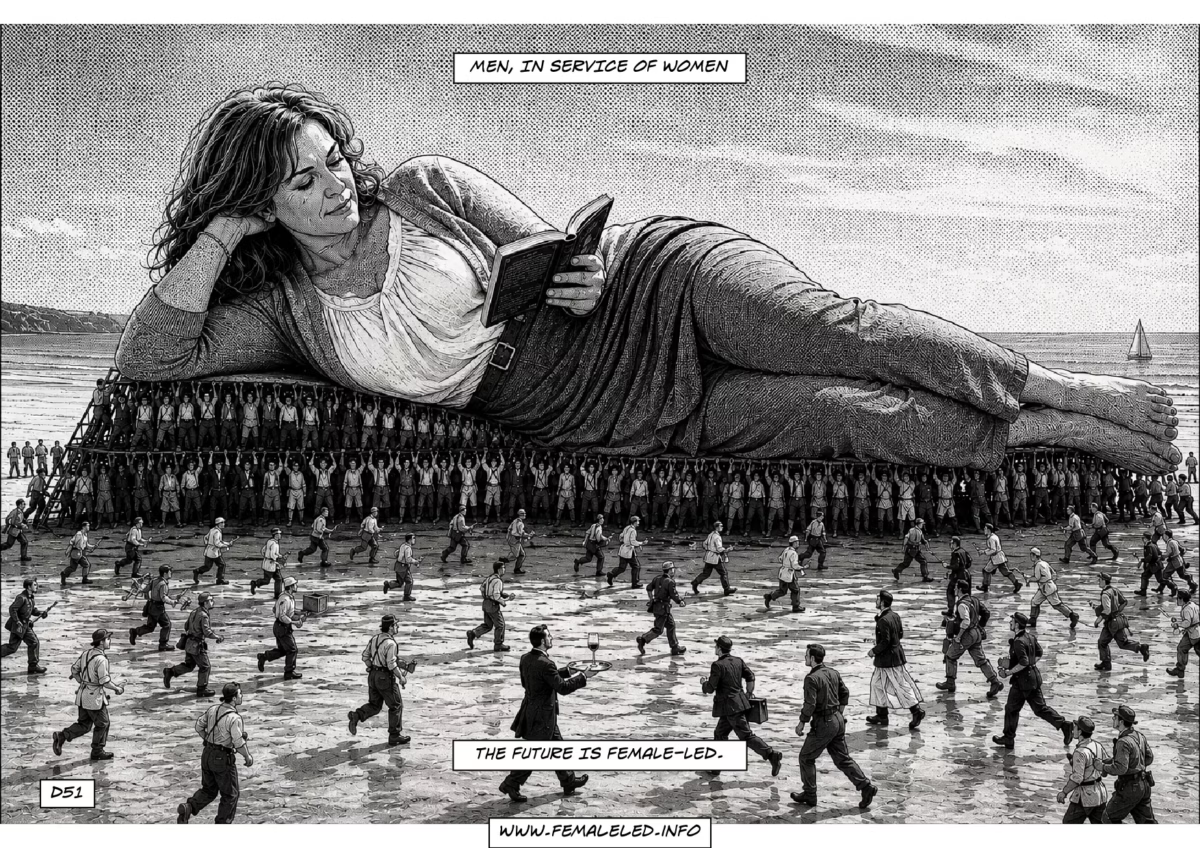
The women who came before you got to burn something down. The vote, the bank account, the marriage bar, each generation took its turn with the matches, and thank goodness they did. But here is the delicious thing about your turn, darling: the demolition is finished.
Your inheritance is a cleared site and a man who has already asked, sincerely, on his knees, to carry the bricks. The question is no longer what you are permitted to dismantle. It is what you intend to build in full view of the neighbours, with your name on the deeds and his signature wherever you decide it belongs.
What follows is seven women who built. Not performed, built. Nothing on this list is a gesture that can be dropped when company changes. These are standing facts, filed and witnessed, the sort of thing a stranger could learn from paperwork without ever seeing the couple in a room together. Which is rather the point.
The woman who heard him vow it
Helena kept one word in the ceremony that everyone else’s wedding had quietly retired. He vowed to love, to cherish, and to obey. She vowed to love and to cherish, and stopped there, and let the pause do its work in a marquee full of both families.
One word. Her mother heard it. His mother heard it. The registrar read it back without blinking, because the word is not illegal, darling, merely abandoned, and abandoned property belongs to whoever picks it up.
Helena will tell you the vow itself took two seconds and the certainty has lasted six years. Not the certainty that he obeys; she had that already, settled at home long before the invitations went out. The certainty that it is on the record. When he hesitates, which is rare, she does not remind him of a private arrangement. She reminds him of a public one. There are witnesses. He chose them.
The woman who signs the housekeeping
Priya’s husband is paid monthly, which is to say Priya is paid monthly, since his salary lands in her account and always has, since the honeymoon. At the start of each month he receives his housekeeping. She sets the amount. She reviews it annually, in January, from the good chair, glass in hand, while he stands and waits to hear the number. The review is genuinely a review: performance is discussed.
And she uses the word. Allowance. At dinner parties, plainly, the way you would say mortgage or school run. She watched a table full of couples go quiet over it once and described the silence to me as the most satisfying thing she owns.
Here is what Priya says changed, and listen closely because it is not what the nervous would predict. She thought she was taking on the money. What she actually took on was the household’s terms. Every standard in that house now has a budget line and a signature, and the signature is hers. He has not checked a balance in nine years. He describes this, unprompted, as restful. She describes it as correct.
The woman whose name is on everything
There was a legal doctrine, once, that folded a wife’s entire existence into her husband’s. She could not own, could not contract, could not exist on paper except through him. A covered woman, the law called her.
Margot thought that was a perfectly good idea pointed in the wrong direction.
The house is hers. The deeds, the mortgage, the accounts, the investments, the car on the drive and the one in the garage: hers, singular, by design and not by accident. Her husband is, on paper, a man who lives in a woman’s house, and every mortgage adviser, conveyancer and accountant who has ever handled their affairs has discovered it in the ordinary course of business, read the file twice, and adjusted who they address.
Margot’s word for the feeling is calm. Not triumph, calm. The paperwork finally tells the truth. Most couples live one arrangement and file another; the world believes the fiction and the couple maintains it, which is work.
Margot retired from that work entirely. Her life and her filing cabinet agree with each other, and she sleeps like a woman audited and found accurate.
The woman his signature needs
Sophie’s husband cannot open an account, take a loan, or sign anything binding without her. Not as a habit, as a mandate. The arrangements sit with their solicitor: powers of attorney, account authorities, her sign-off structural rather than sentimental. Where a wife once needed her husband’s countersignature to get a chequebook, he needs hers, and the professionals who administer it all know.
That last part matters more than it first appears. Sophie did not just arrange her marriage; she enrolled an audience. The solicitor knows. The accountant knows. The bank has it flagged on the file. An entire small ecosystem of sensible people in good suits now participates, briskly and without comment, in the administration of her authority. She never has to demonstrate a thing. The institutions demonstrate it for her, in triplicate, with a compliment slip.
The woman who renamed him
Elena’s husband answers to a name his parents never gave him. She chose it in their second year, first as a private word, then at home, then in front of friends, and the friends adopted it the way friends adopt anything used with total confidence: without ever being asked to. His mother still uses the original. Almost nobody else does.
Parents name what they bring into the world, darling. That is what naming is: the privilege of the one who takes responsibility for a thing’s existence. Elena will tell you the first time a colleague of his used her name for him, casually, at a barbecue, not knowing its history, she felt something proprietary settle in her chest that she has never quite had words for. He has words for it. He says the old name feels like a coat that belonged to someone he used to be. Only his passport remembers, and passports expire.
The woman his career reports to
When the promotion was floated, Daniel did not call his wife to share the news. He called Rachel to make the request. That is the structure: his career exists at her pleasure, she approved the job he holds, and any change to it goes through her before it goes anywhere near his manager. She has said yes twice. She has said no once, for reasons of her household’s design that were hers to weigh and not his to audit, and the no held.
Understand what Rachel actually possesses here. Work is where a modern man keeps his whole idea of himself: his hours, his worth, his story at parties. Rachel holds the deed to it. Not his pay, though she has that too. The thing itself, the identity, filed under her authority with the rest of the household’s assets. She says the yeses are pleasant but the no was the moment she understood her own signature. Nothing she has approved has ever taught her as much as the one thing she declined.
The woman on his CV
The quietest arrangement on this list is a single line in a document sent to strangers. Career break: supporting my wife’s career. Written by him, in his own hand, on his own CV, read by every recruiter who will ever process him.
Anna calls it the proudest one, and she has thought carefully about why. The vow had an audience she chose. The accounts have an audience of professionals bound to discretion. But the CV goes out into the world addressed to people neither of them will ever meet, and it announces, in his voice, where his ambitions rank. She did not write the line. She approved it, the way she approves anything of his that leaves the house, and then she finished her coffee at the kitchen table while he pressed send on a formal notification to the professional world that he belongs to someone.
What the paperwork does for the rest of us
Notice what none of these women is doing. Performing. There is no scene to sustain, no audience to manage, no moment that has to be staged and restaged. Helena’s vow sits in a registry. Margot’s deeds sit at the Land Registry. Priya’s standing order executes itself on the first of the month whether anyone is watching or not. Each of these women handed the work of display to an institution and went back to her chair, and the institutions have been performing beautifully ever since, because that is what institutions are for. It is what they always did for men; the machinery was never the problem, only the direction it faced.
And every filing is a proof of concept. Somewhere a woman hears the word obey at a wedding and goes home thinking. Over dinner a conveyancer mentions an unusual file to his wife. In an office somewhere a recruiter reads one line on a CV and cannot stop reading it.
You do not owe the world a demonstration, darling. Your pleasure is reason enough and it requires no committee. But since you are building anyway, build where it shows.
Over to you
So. Pick one. Not all seven, one, the one that made something in you sit up while you read. Say the word allowance at your next dinner party and hold the silence. Ring the solicitor. Put the house in your name at the remortgage. Let him draft the line for his CV and bring it to you for approval, because everything that leaves the house comes past you first, and this should be no exception.
The women before you took the machinery apart to prove it could be stopped. You get to prove something better: that it runs beautifully in the other direction. One filing at a time, in full view, with your name on it.
His obedience will carry the weight. That is what it is for. Yours, darling, is the signature.

Powerful. As a male I felt a growing submission as I imagined myself in relationship with a woman who implemented these. Thank you.
The woman who renamed him.
My slave name is dirt. Not even allowed the use of a capital letter at the start.
Just dirt….dirt beneath her feet, nothing more than that.
dirt!
What amazing scenarios. To live under a woman in charge should be the goal of every man. It is the only life worth living. The woman is far superior in every way to man and should be every man’s life purpose to serve and elevate and defer leadership with full love and devotion to their goddess and every woman they interact with.
I never really looked that deeply into those issues. I always shared everything with my wife. But from the perspective your coming from, I never shared anything? Her name, opinions, and directives come 1st.
Ms. Boulder:
Thank you for these lovely examples of men fully deferring to the leadership of the women they’re privileged to be in the company of. I specifically appreciate the public admission of “obey” during Helena’s wedding ceremony and her submissive partner’s public acceptance and acknowledgment of his subservient status to his wife. Perfect. I have long believed that FLR dynamics should be more open and shared and that there should be no shame in male obedience to women. Your family will always love you; your friends will support you and those who do not – well, perhaps they’re really not the friends you thought they were. FLR couples need to stop living their smart, woman-centric and led lifestyle in the shadows. So yes!
I also love the idea of a man relinquishing his name to assume one chosen for him by his commanding partner. He is, after all, her pet and property. He is fortunate to be in her presence. Why shouldn’t a dominant woman be able to reconfigure some of the more instrumental aspects of his life: to change his name, assert authority over his finances and professional future and naturally, control his sexuality and reimagine it to prioritize her needs.
How I wish I could live in a world designed and ruled by You Madame Cat Boulder! Truly! I Here, You wrote precisely what so many of us – men, and certainly a growing number of Women – dream of, a place where Women wield all responsibilities and influence without raising their voice. A world under Feminine direction, with manners, education, proper behavior, harmony, efficiency, peace…
Eleanor Roosevelt said: “The future belongs to those who believe in the beauty of their dreams.” Thus, what more beautiful dream than the world You brilliantly depict, where husbands will take the family name of their Wife as well? Very few do so nowadays, however times are changing fast…
Avec mes compliments, Madame.
Love this post! Great tips for any FLR.
Having her name on deeds and bank accounts should be automatic for any FLR. So should him granting her his power of attorney.
I love the other ideas, too. I’d never thought of having Girlboss rename me, but it should certainly be her prerogative. More than that, it’s an excellent symbol of his rebirth into a life devoted to supporting and uplifting his goddess.
Regarding “The Woman His Career Reports To”, this earlier post from Cat is one of my favorites. It really crystallizes how the FLR couple should handle big life decisions:
https://femaleled.info/training-your-man-to-articulate-his-needs-in-a-female-led-relationship/
Dear Ms. Boulder
As a deeply submissive male longing for my Superior Wife to own me and for me to serve Her, I would accept any and all of these if that was what my Wife wanted.
If i have to pick one I would start with the one where Goddess-Wife’s name was on everything, I would assume that this also effectively would mean that She would keep complete control of the finances and I would have no say in how Her money was spent. My salary would go into a bank account in Her name and I would own nothing, being completely dependent on Her.
The woman whose name is on everything resonates with me as it most closely resembles my personal situation. She controls all the banking/investment accounts, insurance policies, has Her name on the house and the car. I use Her credit card when I do the shopping (which is always). She also has her name on all the retail points cards so She gets an exact list of all purchases in almost real time. If i need cash for something She issues it to me if She agrees it’s needed. We/we both find this arrangement optimal for our situation though on occasion She’ll pointedly remind me Who exactly is in charge here. Her house, Her money, Her rules.