
The tease, not the lock, is what gets the garage cleared

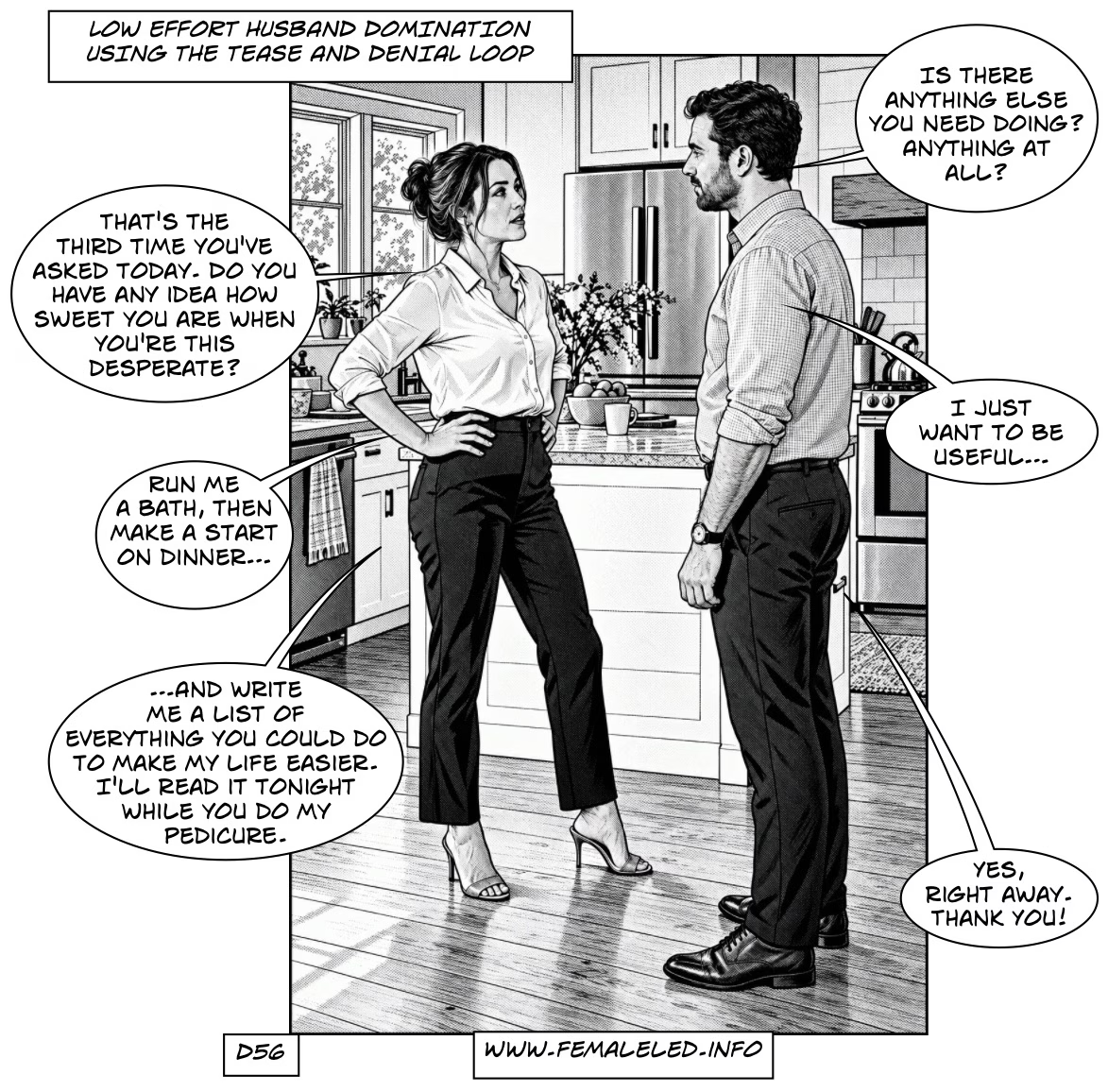
She has not touched him since Tuesday.
By Thursday evening the garage has been cleared, which it has not been since COVID. Her mother’s birthday lunch is booked, at the table by the window she likes. The car has been washed without anyone mentioning it. Now he is hovering in the kitchen doorway, asking for the second time whether there is anything else she would like.
There is, as it happens. She would like him to keep asking.
She has not given a single instruction all week. No list, no raised voice, nothing said twice. She simply has not touched him. On Wednesday night she rested a hand on his thigh for the length of one sentence, then took it back to turn a page. The rest ran itself.
That is the loop. Most women who lead are already running half of it, and half a loop is just a frustrated man. Run the whole thing, darling, and it does the steering for you.
Why the loop matters
Denial is not new to anyone reading this. If he has ever worn a lock, you have met the man it produces: attentive, helpful, suddenly fascinated by your opinion of the curtains. There is something deliciously revealing about a man with twenty-three days of pent-up energy and a pair of gardening gloves.
When we asked about chastity, the difference between the sexes was plain. Men were often drawn to the fantasy. Women were more interested in what the arrangement produced in real life. The women were right, and this piece is for them.
The trouble is that denial, left to run on its own, goes stale. The want builds, then it sours. He sulks, he fusses, he checks the calendar, and his mood becomes your problem. A frustrated man is not an obedient one. He is just a frustrated one.
The loop, however, fixes that. It has four stages, each feeding the next, and it costs you less effort every time it comes round.
The tease and denial loop, stage by stage
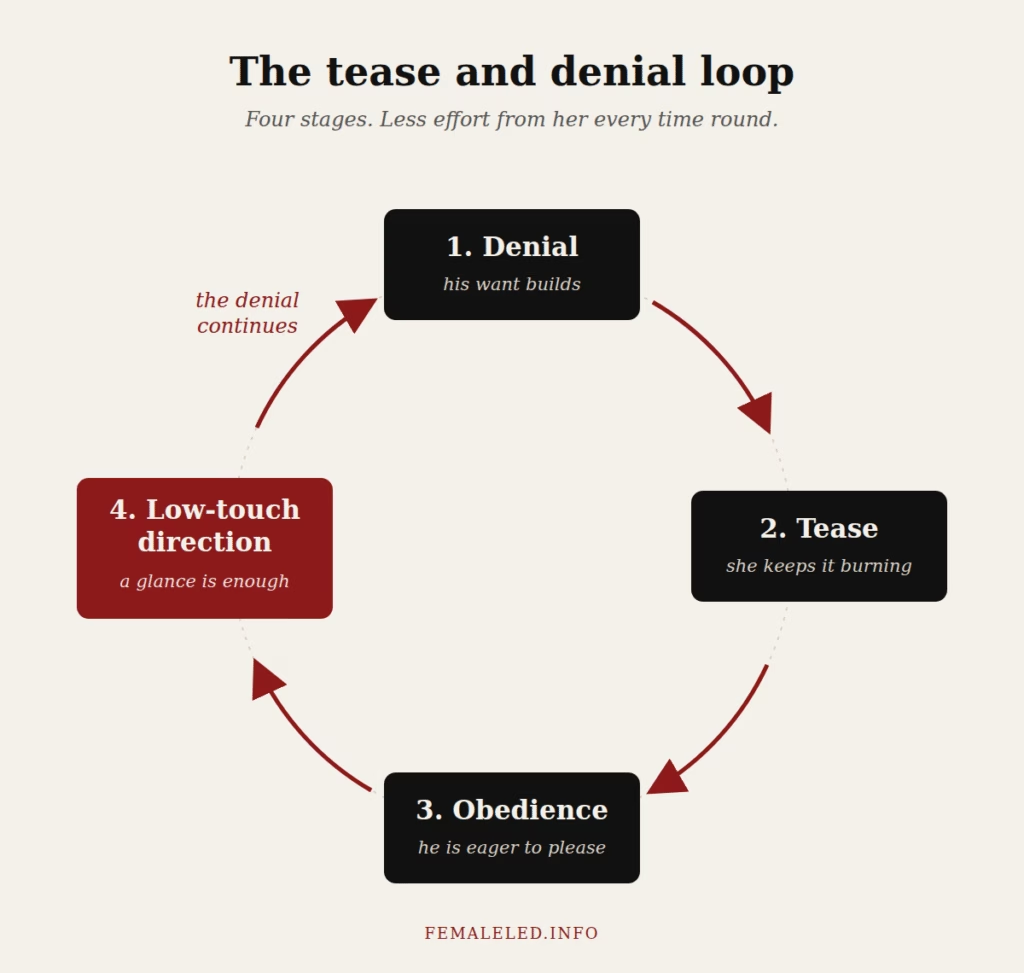
Take an ordinary Wednesday and follow it round.
Stage one: denial
Denial comes first because everything else runs on what it produces, which is want.
There is science under this, so let us be exact about what it says. For three decades Kent Berridge and Terry Robinson have shown that “wanting” and “liking” are separate systems in the brain. Liking is the pleasure itself. Wanting is the pull towards it, and the pull can grow while the pleasure stays exactly where it was. Of course, their work is largely on rats and addiction, not marriages. Even so, the principle travels: what drives a man is the wanting, and you control the wanting.
Denial feeds the pull and withholds the pleasure. Every day you hold the key, the pull grows.
Take Helen, for example. She is fifty-one, runs a surveying practice, and has been married to Mark for nineteen years. The lock went on after Christmas. By day six he was ironing her blouses unasked. By day twelve he was up before her to warm the car and scrape the windscreen. Twenty days in, she noticed he had stopped asking when. He had started asking what. “That was the day,” she says, “I knew the key was doing the talking.”
Do: set the length yourself, and keep it to yourself.
Don’t: announce an end date. A man who knows release comes on the fourteenth coasts until the thirteenth. A man who doesn’t know is useful every single day.
Stage two: the tease
Denial builds the want. The tease keeps it burning, and keeps it pointed at you.
Left alone, a denied man’s want drifts. It wanders into self-pity, into the calendar, into wondering whether you have forgotten him. Then the tease brings it back. A hand that stays a moment too long. A look held across the dinner table. Your lips at his ear, one word, then nothing. Each one reminds him who holds the key, and that she has not forgotten him at all. She is simply not finished with him yet.
In 1997 Wolfram Schultz and colleagues recorded dopamine neurons in monkeys. When a reward arrived unexpectedly, the neurons fired hard. Once the reward became predictable, the firing moved to whatever signalled that it was coming. That is monkeys and juice, not husbands, so don’t overclaim it. The shape is still worth knowing: the signal carries the charge. Your tease is the signal. It keeps the anticipation alive in a way that silent denial cannot.
The 58 ways to tease a man in chastity make a good toolkit. Use them lightly, often, and unpredictably. He should never quite know when the next one is coming.
Do: keep it brief. Seconds, not minutes. The tease is a spark, not a scene.
Don’t: let the tease drift into release. A tease that ends in release resets the loop early, and you have spent the want before you used it.
Stage three: obedience
A man who is denied, and kept keyed up by the tease, becomes remarkably easy to lead. He is eager, attentive, quick to do as he is told, because pleasing you is the only road to what he wants. Obedience is not something you have to extract at this point. It arrives.
He also likes it. In our survey of more than 350 submissive men, fulfilment rose with structure, from 6.68 out of 10 at Level 1 to 9.05 at Level 4. That is self-reported and it is correlation, so it does not prove the structure caused the contentment. It does suggest that the men with more rules are not quietly suffering. They are settled. A man who knows what you want of him no longer has to guess.
Rachel and Simon have been married twenty-two years. For the first two years of their FLR she ran denial the way most women do: on, off, and mostly forgotten. By the second week Simon was sulking, and she was managing his mood on top of everything else. What changed was the tease. Instead of letting the denial run in silence, she kept it alive. A hand on his chest as she passed. Her lips at his ear on the stairs. Within six weeks the sulk had become something else entirely: a man hovering to be useful, finishing jobs she had not yet mentioned. “I used to manage him,” she says. “Now I just notice him.”
Do: acknowledge good work promptly and briefly. A word, or a hand on the back of his neck as you pass.
Don’t: pay for every task with release. Once release becomes his wages you are running a vending machine, and he will start setting the exchange rate himself. That is your job.
Stage four: low-touch direction
This is the payoff, and it is why the loop belongs to you and not to him.
A man this eager needs very little steering. You do not write the list. You do not repeat yourself. A glance at the unwashed car, and he is out there with a bucket. A remark that you could not find anything in the garage, and by Thursday you can find everything. Your effort drops to almost nothing, and what you want gets done anyway. It is the natural partner to standing orders: the best obedience is the kind you never have to ask for twice.
After all, that is the real prize. In our Dominant Women survey, 61.8% named housework as their favourite task to delegate. The loop lets you delegate without the admin.
Joanna wanted a quiet weekend. Her sister was coming to stay, she had six coming for supper on Saturday, and she wanted nobody asking her anything. On Friday evening she said none of this. She mentioned her sister’s train time, once, and went back to her book. By Saturday noon the spare room was made up, the shopping done, and a menu was on the fridge awaiting her approval. She approved it. She did not touch him until Sunday night, and then only briefly. He thanked her.
Then round it goes. The denial continues. Release, or not, is your call, and so is the start of the next cycle. Most weeks the answer is simply: not yet.
Do: say it once, lightly, and let him work out the rest. The less you say, the more he listens.
Don’t: slip back into lists and reminders. If you are managing him again, the loop has stalled. Check the tease: it has probably gone quiet.
Back to the chair
Thursday again. He is in the doorway, still asking whether there is anything else.
This is where most people misread tease and denial. They think she is withholding something from him. She isn’t. She is issuing currency. Denial prints it, and the tease raises its value. By the time it reaches stage four, a single glance buys a cleared garage. You decide what his attention buys, when he spends it and when you print the next batch. He works for you, and you pay him in attention.
Most women who lead sit around Level 2, edging towards 3. Our surveyed women average 2.72 and would like to be at 3.33. If that is you, don’t start with a lock and a calendar. Instead, start with one week and one pleasure you hold back. Tease him lightly, daily. Then mention, once, one thing you would like done, and see what arrives.
Then decide, from the chair, whether he has earned the next week.
He hasn’t. Let him ask again.




A big thing that came from the training course, and that shows up again here, is the importance of minimizing the work a woman has to put into managing her servant as much as possible. It’s not enough to do the work, it has to be done so that the service doesn’t demand time or effort from her. That’s not something I had really thought about before I found this site.